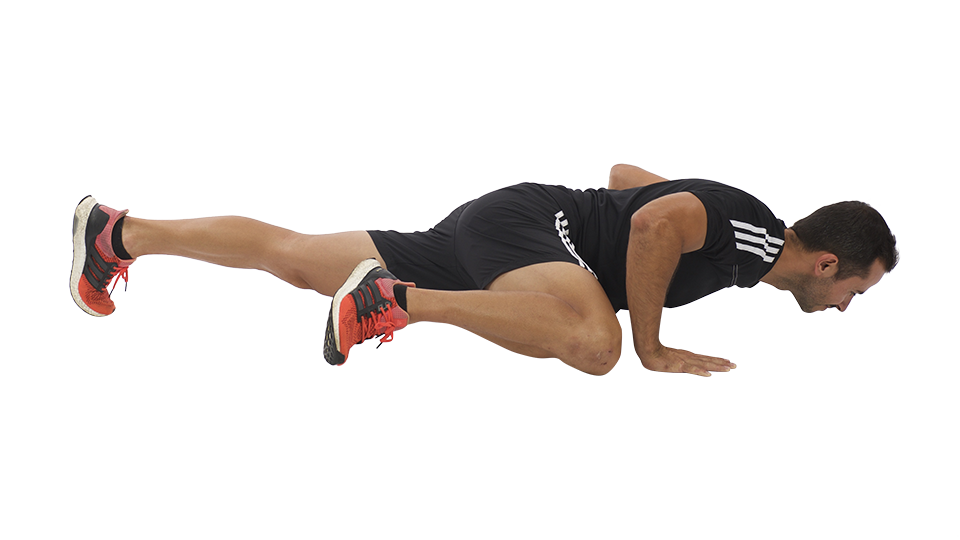
At-home strength training can be as effective as training at the gym, provided you plan each set of exercises with the same commitment you already bring as an amateur or professional athlete. Easy activities that do not require much equipment, such as push-ups, planks, and squats, can be done anywhere, as long as you have a little space.
CAN STRENGTH TRAINING WORK WHEN DONE AT HOME?
There are many ways to exercise at home. Strength training can involve all the body's muscles and aims to challenge and develop them as you exert opposing force, such as pushing against a wall, lifting dumbbells, or pulling on a resistance band[1].
Even without all the equipment and machines at hand, it is possible to achieve results using only your own body weight. However, it is recommended that you have a mat or exercise rug and, if you prefer, items that can be purchased at sports stores, such as jump ropes, dumbbells, and resistance bands. In any case, you do not need a mini gym at home to make progress in your strength training.
At-home strength exercises are good options when you cannot go to the gym or as part of a routine for those who work from home. For this, you also need to clear a little space in a room in the house or in the garden. Create a little corner that serves as your exercise oasis.
7 TIPS FOR EFFECTIVE STRENGTH TRAINING
For effective strength training at home, put together a workout routine and stay focused on your goals. It is also important to consult a fitness professional to help you put together sets of exercises that are right for you, as well as safe.
Here are some tips for strength training at home:
1. ALTERNATE FAST AND SLOW MOVEMENTS
According to a study[2] published in 2020, fast and slow repetitions are important in strength training. Slow movements are more effective in helping build muscle, as they allow muscles to remain under tension for longer. On the other hand, fast movements help build strength and muscle power.
To train at home, opt for a combination of fast and slow movements, performing both perfectly. Careful execution is essential to help achieve the intended goals.
2. TRY DIFFERENT EXERCISE COMBINATIONS
Training at home is also an opportunity to make adjustments to your workout and try new exercise combinations. To maintain fitness, you may need to use new methods to achieve the same results, such as increasing the volume of activities that only require body weight.
Although it is important to stick to a routine you are committed to, varying your exercises can help prevent boredom and help you pursue different goals, such as building muscle, improving physical endurance, and developing flexibility.
3. IMPROVE YOUR RANGE OF MOTION
Range of motion is fundamental when exercising and refers to the degree of movement a joint can achieve when we lift dumbbells or perform squats, for example.
According to a chart created by the United States Centers for Disease Control and Prevention3, an adult should be able to flex their hip, for example, at an angle of up to 130 degrees.
Including flexibility exercises, such as yoga poses, and stretching in your at-home exercise routine is a great way to help improve your range of motion.
4. TRY UNILATERAL EXERCISES
Bilateral exercises work the muscles on both sides at the same time, while unilateral exercises work one side at a time. One of the advantages of incorporating unilateral exercises into your workout program is that they also place more pressure on your core muscles, working your abdominals and lower back.
Unilateral exercises can also help prevent possible injuries when there is an imbalance in the body, which can overload one side during physical activity.
5. FOCUS ON SUPERSETS
Supersets are intense strength workouts in which you perform one exercise after another with little rest between sets. Breaks are important to catch your breath and rehydrate.
Supersets are great options for boosting your workout, allowing you to do more exercises in a given period. While your muscles recover from one set, you will be performing another with different stimuli.
6. INCLUDE NEW EXERCISES IN YOUR WORKOUT
Trying new exercises is another way to beat boredom, but also to challenge your limits. Since you will not have the same variety of equipment as at the gym, look for alternative activities so you can feel like you are making progress every day and working your whole body.
Now may be a good time to include those exercises you once considered challenging, or gradually increase the intensity or speed of your workout, always respecting your limits and under the guidance of a fitness professional.
7. INCREASE REPETITIONS FOR GREATER GAINS
If you feel that training at home is not as effective as training at the gym, you can increase the number of repetitions in your sets to achieve greater gains. Generally, exercises with more repetitions are used to increase muscular endurance and physical fitness.
EXERCISE TIPS FOR A STRENGTH WORKOUT AT HOME
You have probably already done the exercises below as part of your workout, as they are classic and effective activities. They can be done anywhere without the need for equipment:
-
Squat
There are many variations of the good old squat. In its traditional form, stand with your feet shoulder-width apart. Bend your knees, lowering your hips until they are slightly below knee level. Push your buttocks back, as if you were sitting in a chair. Keep your back straight at all times. Then extend your legs to return to the starting position. Perform sets of repetitions. -
Lunge
To perform a lunge, bend one knee forward until the thigh of the forward leg is parallel to the floor. The front foot should be fully planted on the ground, and the back heel should remain raised without touching the floor. -
Bridge
The bridge is a simple but effective exercise. Lie on your back on a mat, keep your arms straight by your sides, bend your knees, and keep your feet on the floor. Then contract your glutes and abdominals and lift your hips toward the ceiling, so that your stomach and back leave the floor. Your body weight should be supported by your shoulder blades and feet. Keep your body aligned. Hold the position for a few moments and repeat once more. -
Push-up
Lie on the floor face down and place your hands on the ground below your shoulders. Extend your elbows, raising your entire body at once. Keep your back straight and aligned with your body. Bend your elbows and return almost to the starting position without letting your body touch the floor. Pause briefly and repeat the movement throughout a set of repetitions. -
Plank
To get into a plank, start in a push-up position with your body extended on the floor. Bend your elbows to 90 degrees and rest your weight on your forearms. Keep your torso straight and rigid and your body in a straight line—from your ears to your toes, without sagging or bending! Keep your head relaxed, without tension in your neck, and look at the floor. Breathe calmly. Hold the position for as long as you can.
For an equipment-free strength workout at home, combine the tips above. With commitment, you will continue on the right path to maintain your fitness and achieve your goals.
References:
1. Harvard Health Publishing - Harvard Medical School. 7 tips for a safe and successful strength-training program. Available at:
https://www.health.harvard.edu/exercise-and-fitness/7-tips-for-a-safe-and-successful-strength-training-program
2. Yendrizal,. (2020). The Effect of Weight Training Using Fast and Slow Repetition Movement Towards Thigh Muscle Hypertrophy. Available at:
https://www.researchgate.net/publication/344096583_The_Effect_of_Weight_Training_Using_Fast_and_Slow_Repetition_Movement_Towards_Thigh_Muscle_Hypertrophy
3. Centers for Disease Control and Prevention. Normal Joint Range of Motion Study. Available at:
https://www.cdc.gov/ncbddd/jointrom/index.html


